
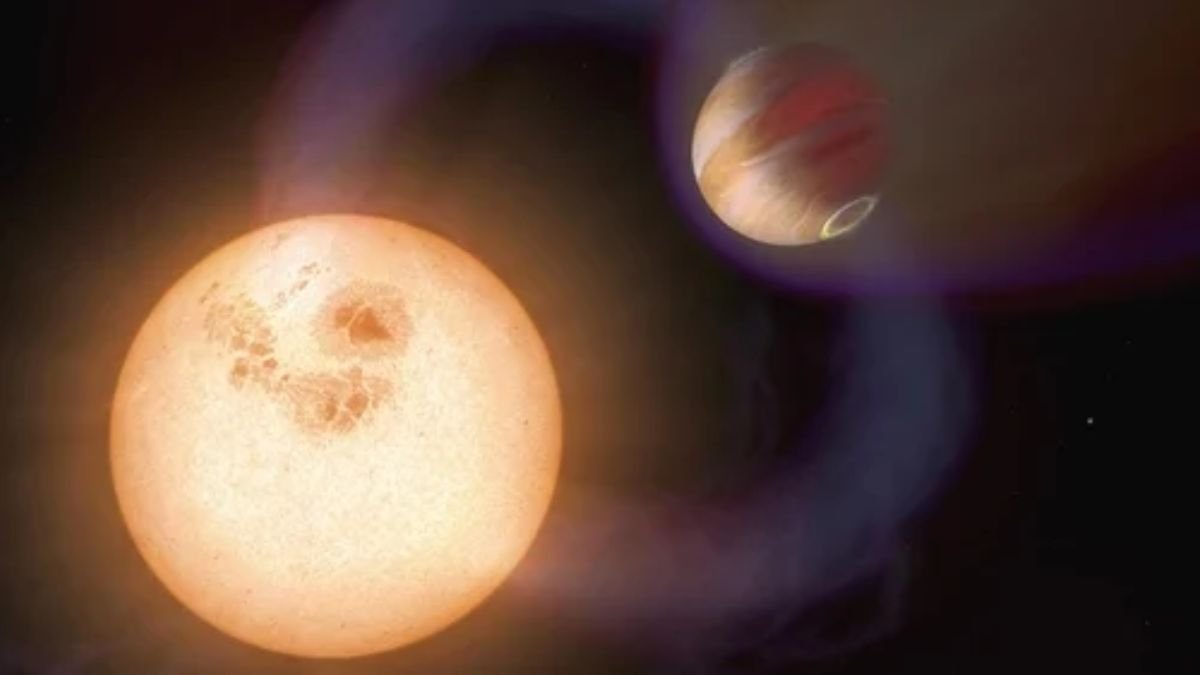
A new astronomical study has provided the most compelling evidence so far that planets beyond our Solar System can generate magnetic fields similar to those found on Earth and several other planets orbiting the Sun.
By examining atmospheric winds on seven massive gas giant exoplanets, researchers identified patterns that strongly suggest the presence of planetary magnetic fields. The discovery offers new insights into how exoplanets function and may eventually improve scientists’ understanding of the conditions that help planets maintain stable atmospheres over billions of years.
Magnetic Fields May Be Common Beyond the Solar System
Magnetic fields are invisible force fields produced by the movement of electrically conductive material deep within a planet’s interior, typically a molten metallic core, combined with planetary rotation.
In our Solar System, global magnetic fields exist on:
- Earth
- Mercury
- Jupiter
- Saturn
- Uranus
- Neptune
Only Venus and Mars currently lack strong global magnetic fields.
The new findings suggest that magnetic fields may also be widespread among exoplanets orbiting distant stars.
Study Focused on Seven Extreme Gas Giants
The research examined seven giant exoplanets known as hot Jupiters.
These worlds are comparable in size and composition to Jupiter but orbit extremely close to their host stars, resulting in extraordinarily high temperatures.
Characteristics of the Studied Planets
The planets:
- Range from roughly Jupiter’s mass to more than three times heavier
- Orbit much closer to their stars than Mercury does to the Sun
- Complete very short orbital periods
- Are tidally locked, meaning one side always faces the star
As a result, one hemisphere experiences constant daylight and extreme heat, while the opposite side remains permanently dark.
Unexpected Wind Behavior Caught Scientists’ Attention
Researchers initially expected hotter planets to generate stronger atmospheric winds.
Normally, increased energy entering an atmosphere should create more vigorous weather patterns and faster air circulation.
However, observations revealed the opposite trend.
Hotter Worlds Had Slower Atmospheric Mixing
Lead researcher Julia Seidel from the Lagrange Laboratory at the Observatoire de la Côte d’Azur in France explained that the hottest planets showed surprisingly weak atmospheric circulation compared to cooler hot Jupiters.
This finding challenged conventional atmospheric models.
According to researchers, the enormous energy received from the host stars must be dissipated through another mechanism.
The most likely explanation is the interaction between charged particles in the atmosphere and a planetary magnetic field.
Magnetic Fields May Be Slowing Atmospheric Winds
Scientists propose that magnetic fields act as a braking system within these exoplanet atmospheres.
When electrically charged particles move through a magnetic field, they experience forces that can reduce atmospheric motion and alter circulation patterns.
Powerful Winds Still Sweep Across the Planets
Even with this apparent braking effect, the planets experience extraordinary winds.
Researchers measured wind speeds reaching:
- Up to 25,000 kilometers per hour
- Approximately 15,500 miles per hour
These speeds exceed those found on Jupiter and rank among the fastest atmospheric winds ever observed.
The fact that hotter planets showed weaker-than-expected atmospheric mixing strongly supports the idea that magnetic interactions are influencing their weather systems.
Strongest Evidence Yet for Exoplanet Magnetic Fields
Although astronomers have long suspected that many exoplanets possess magnetic fields, obtaining direct evidence has proven challenging.
Previous studies often focused on individual planets and produced less conclusive results.
A Population-Wide Trend Emerges
Rather than analyzing a single exoplanet, researchers examined a broader sample and identified a consistent pattern across multiple worlds.
The repeated relationship between temperature and wind behavior provides some of the strongest observational support to date that these planets generate magnetic fields.
How Strong Are These Magnetic Fields?
The study indicates that the magnetic fields of the seven hot Jupiters are generally weaker than Jupiter’s exceptionally powerful magnetic field.
However, their strength appears comparable to magnetic fields observed on several planets within our Solar System.
Jupiter Remains the Benchmark
Jupiter possesses the largest and strongest planetary magnetic field in the Solar System.
While the studied exoplanets do not appear to match Jupiter’s magnetic intensity, their fields are substantial enough to influence atmospheric dynamics on a planetary scale.
Why Magnetic Fields Matter
Magnetic fields are important because they help protect planetary atmospheres from being stripped away by stellar radiation and charged particles.
Over long periods, this protection can influence a planet’s evolution and habitability.
The Example of Mars
Mars provides a well-known example of what can happen when a magnetic field disappears.
Scientists believe the Red Planet once generated a global magnetic field. As its interior cooled billions of years ago, that protective shield weakened and eventually vanished.
Without a strong magnetic field:
- The atmosphere gradually thinned
- Surface conditions became harsher
- Liquid water became increasingly difficult to sustain
Today, Mars possesses a thin atmosphere and an environment considered largely inhospitable to life.
Magnetic Fields and Habitability
Researchers emphasize that magnetic fields alone do not determine whether a planet can support life.
However, they can play a critical role in maintaining the conditions necessary for habitability.
Supporting Long-Term Atmospheric Stability
A stable atmosphere helps:
- Regulate surface temperatures
- Maintain atmospheric pressure
- Protect against harmful radiation
- Support the existence of liquid water
On Earth, these factors have been essential for the development and survival of life.
Scientists believe understanding magnetic fields on exoplanets could eventually help identify worlds that are more likely to maintain favorable conditions over geological timescales.
A Major Step Forward in Exoplanet Research
The discovery marks an important milestone in the study of planets beyond the Solar System.
By linking unusual atmospheric wind behavior to magnetic field activity, astronomers now have stronger evidence that many exoplanets may possess internal magnetic dynamos similar to those operating on Earth and other planets.
As observational technology continues to improve, future studies may reveal how common magnetic fields truly are across the galaxy and what role they play in shaping planetary environments, atmospheric evolution, and the potential for life elsewhere in the universe.
