
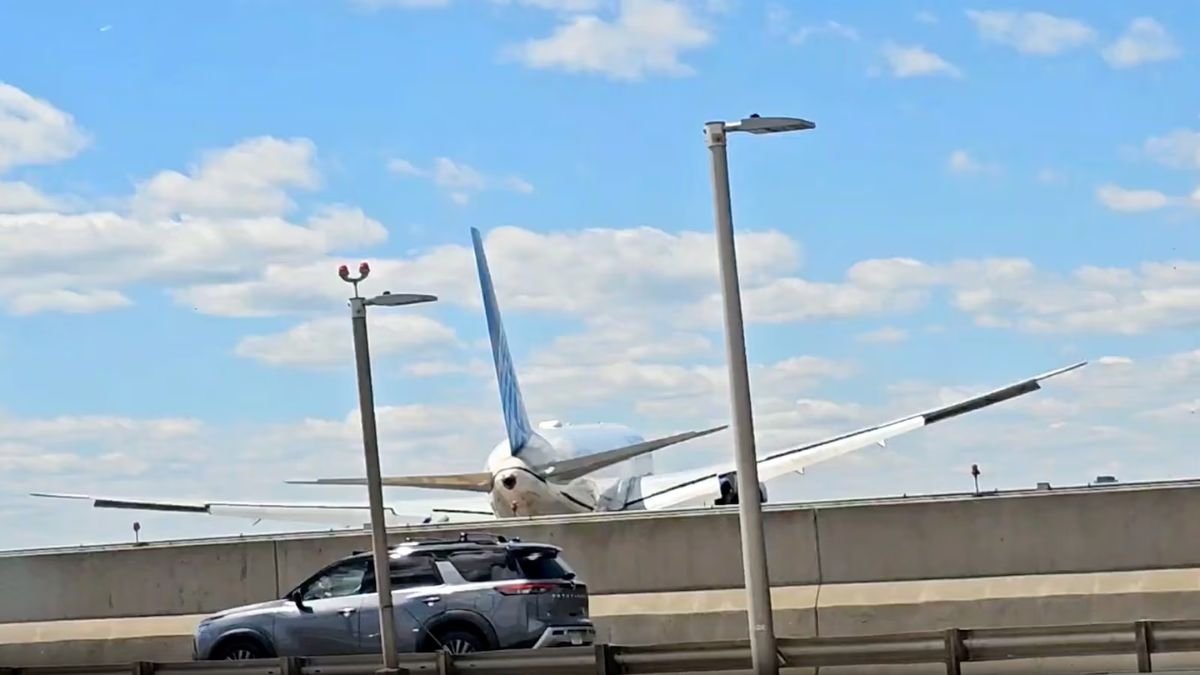
A preliminary investigation by the National Transportation Safety Board (NTSB) has shed new light on the United Airlines aircraft that collided with a light pole while landing at Newark Liberty International Airport earlier this year.
According to the agency’s findings, the aircraft was only 19 feet above the center of the New Jersey Turnpike moments before touchdown, placing it significantly lower than expected during its final approach.
The incident involved United Flight 169, which was arriving from Venice, Italy, in May.
Aircraft Traveled Below Standard Glide Path
Flight data analyzed by investigators showed that the Boeing 767 remained beneath the normal landing glide path for approximately the final three-quarters of a mile before reaching the runway.
As the aircraft crossed above the New Jersey Turnpike at more than 160 mph, a landing gear tire and part of the underside of the plane struck a roadside light pole.
The collision occurred just moments before the aircraft landed on Newark’s Runway 29.
Initial Reports Clarified by Investigation
Following the incident, New Jersey State Police initially reported that the aircraft had also struck a tractor-trailer traveling on the highway.
However, the NTSB’s preliminary findings determined that damage to the truck was caused by debris from the impacted light pole rather than direct contact with the aircraft itself.
Investigators noted that no tire marks or evidence of direct aircraft contact were found on the tractor-trailer.
The truck driver suffered injuries that were not considered life-threatening. Authorities also reported that debris from the pole struck a nearby Jeep.
Cockpit Events Leading Up to Landing
The NTSB report outlines the sequence of events during the final approach.
As the aircraft prepared to land on May 3, the captain reportedly disengaged both the autopilot and auto-throttle systems.
The captain later told investigators that the aircraft became faster than intended while turning into a headwind. To compensate, he reduced engine power, allowing the aircraft to return to a stable airspeed.
Investigators also noted that moderate turbulence caused by wind gusts was present during the approach.
First Officer Raised Concerns Before Touchdown
The report indicates that the first officer warned the captain that the aircraft appeared to be both “slow” and “a little low” during the landing sequence.
Several crew members later described hearing or feeling something unusual during touchdown.
According to interviews conducted by investigators:
- The captain reported hearing a “thump.”
- The first officer felt a “mild jolt.”
- Flight attendants located at the rear of the aircraft recalled hearing a loud bang.
At the time, none of the cockpit crew appeared to realize the aircraft had struck a light pole.
More Than 200 People Onboard
The Boeing 767 was carrying more than 200 passengers along with 11 crew members.
Despite the collision, the aircraft completed its landing safely and no injuries were reported among those onboard.
The flight continued to a normal conclusion at Newark Airport.
Significant Damage Found on Aircraft
After inspecting the aircraft, investigators discovered multiple areas of damage.
The NTSB identified three punctures on the lower left rear section of the fuselage. The damage penetrated all three structural layers of the aircraft’s fuselage, leading investigators to classify it as substantial.
Additionally, one of the landing gear tires showed multiple cuts and slashes consistent with impact damage.
Air Traffic Controllers Unaware of Collision
Recordings of communications between the flight crew and air traffic controllers suggest that neither party knew the aircraft had struck the light pole during landing.
The damage was only discovered after the aircraft had safely reached the airport.
Runway 29’s Unique Location
The incident occurred during an approach to Newark’s Runway 29, which begins less than 400 feet from the edge of the heavily traveled New Jersey Turnpike.
Although the runway is not always active, it is frequently used when wind conditions favor that direction of landing.
When aircraft approach this runway, they often pass very low over highway traffic, creating a dramatic sight for motorists traveling beneath.
Investigation Remains Ongoing
The NTSB emphasized that its current findings are preliminary.
Investigators continue to examine the circumstances surrounding the approach, flight path, weather conditions, and aircraft performance. A final report containing the agency’s conclusions and any safety recommendations will be released once the investigation is complete.
