
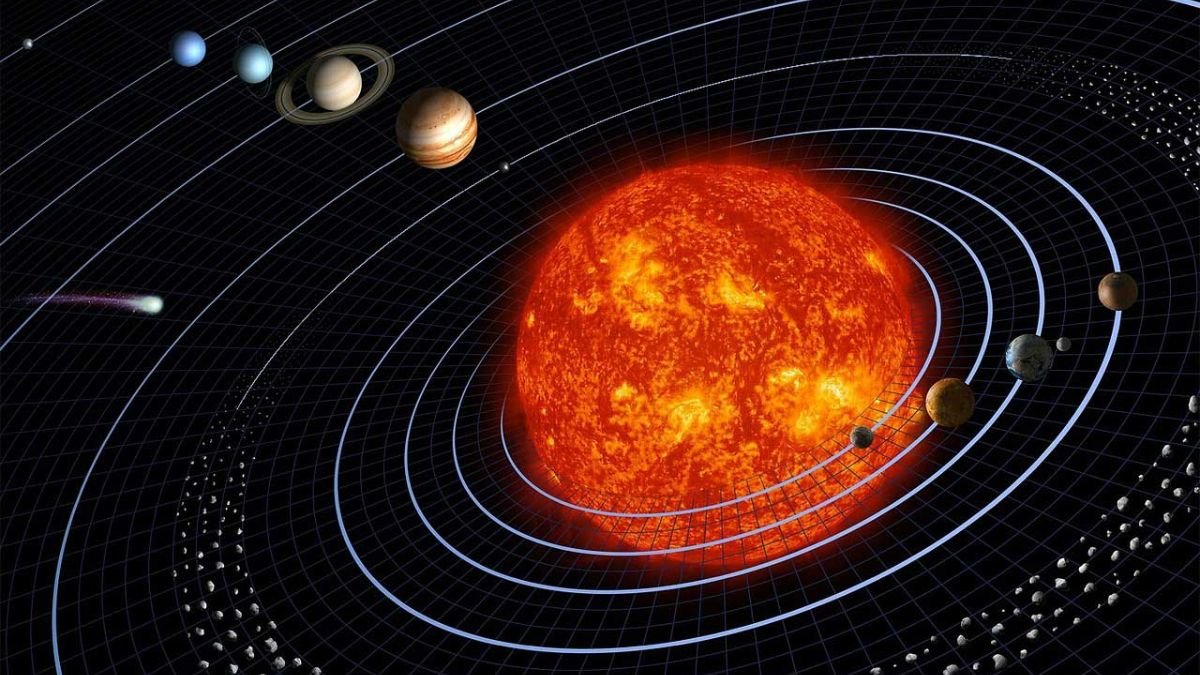
Most people learn that Venus is Earth’s closest planetary neighbor, and for many purposes, that statement is correct. Venus can approach Earth more closely than any other planet and follows an orbit that lies nearest to our own.
However, a study highlighted in a 2019 Physics Today commentary presented a surprising conclusion: when distances are averaged over long periods of time, Mercury is actually the planet that remains closest to Earth most often.
The finding does not overturn our understanding of the Solar System, but it does reveal how different definitions of the word “closest” can produce very different answers.
Why Venus Is Commonly Considered Earth’s Closest Neighbor
Venus has long been regarded as Earth’s nearest planetary companion because it can come extremely close during certain points in its orbit.
When Venus passes between Earth and the Sun, the distance separating the two planets can shrink to roughly 38 million kilometers, making it the closest physical approach of any planet to Earth.
Additionally, Venus closely resembles Earth in size and composition, which further strengthens its reputation as our neighboring world.
Under the traditional definition of “closest”—meaning the smallest distance reached at any point—Venus remains the correct answer.
The Problem With Traditional Distance Calculations
The debate begins when scientists attempt to determine which planet stays nearest to Earth over time.
A common shortcut involves comparing each planet’s average distance from the Sun and subtracting one value from another. Using this method, Venus appears to be Earth’s nearest planet on average.
The issue is that this approach assumes both planets occupy the same side of the Sun, which is rarely the case.
In reality:
- Planets constantly move around the Sun.
- They often occupy very different positions in their orbits.
- At times, they can be located on opposite sides of the Solar System.
As a result, simple distance subtraction does not accurately represent the true average separation between planets.
A More Accurate Method Reveals a Different Answer
Researchers Tom Stockman, Gabriel Monroe, and Samuel Cordner explored the question using more comprehensive calculations.
The Point-Circle Method
One technique averaged distances across every possible orbital position the planets could occupy.
Long-Term Orbital Simulation
The researchers also created a simulation that tracked planetary positions every 24 hours over a period of 10,000 years.
The results showed:
- Mercury was Earth’s nearest planet about 47% of the time
- Venus was closest about 36% of the time
- Mars was nearest about 17% of the time
These findings suggest that Mercury spends more time closer to Earth than any other planet when measured over long timescales.
The Even More Surprising Discovery
The study produced an even more unexpected result.
According to the same averaging method, Mercury is not just Earth’s closest planet over time—it is also the closest planet on average to every other planet in the Solar System.
That includes:
- Venus
- Mars
- Jupiter
- Saturn
- Uranus
- Neptune
At first glance, this conclusion seems counterintuitive, but there is a logical explanation.
Why Mercury Wins the Average-Distance Contest
Mercury orbits very close to the Sun, remaining near the center of the Solar System.
Because of this position:
- It never strays very far from the system’s midpoint.
- It avoids spending long periods on the opposite side of the Sun from other planets.
- It maintains relatively consistent distances from the rest of the planetary family.
Outer planets, by contrast, travel along much larger orbital paths.
As they move around the Sun, they often spend extended periods extremely far from other planets.
Mercury’s advantage comes from consistency rather than occasional close encounters.
What This Discovery Does Not Mean
The findings have generated significant interest, but they are often misunderstood.
Mercury Is Not the Closest Planet During Close Approaches
Venus still holds the record for the nearest physical approach to Earth.
Mercury never comes as close to Earth as Venus can during favorable orbital alignments.
The Solar System’s Structure Has Not Changed
The planetary order remains exactly the same:
- Mercury
- Venus
- Earth
- Mars
- Jupiter
- Saturn
- Uranus
- Neptune
Venus also remains the planet whose orbit most closely resembles Earth’s orbital path.
The study simply answers a different question than the one most people are accustomed to asking.
Why Definitions Matter
The disagreement surrounding this topic is less about mathematics and more about terminology.
If the question is:
“Which planet comes closest to Earth at any point?”
The answer is Venus.
If the question is:
“Which planet remains closest to Earth on average over long periods?”
The answer is Mercury.
Both statements are correct within their respective contexts.
What About Space Missions?
From a practical perspective, spacecraft engineers are generally more concerned with launch opportunities and orbital alignments than average distances.
For mission planning, factors such as:
- Transfer windows
- Orbital geometry
- Fuel requirements
- Closest approach opportunities
are far more important than long-term average separation.
That is why Venus and Mars continue to be key destinations for planetary exploration despite Mercury’s statistical advantage.
A Fascinating Twist on Planetary Trivia
The Mercury finding does not rewrite astronomy textbooks or alter the structure of the Solar System. Instead, it offers an interesting reminder that scientific answers often depend on how a question is framed.
While Venus remains Earth’s nearest planetary companion during close encounters, Mercury quietly spends more time closer to Earth—and every other planet—when distances are averaged across thousands of years.
It is a subtle distinction, but one that has transformed a familiar piece of space trivia into a fascinating lesson about orbital mechanics.
