
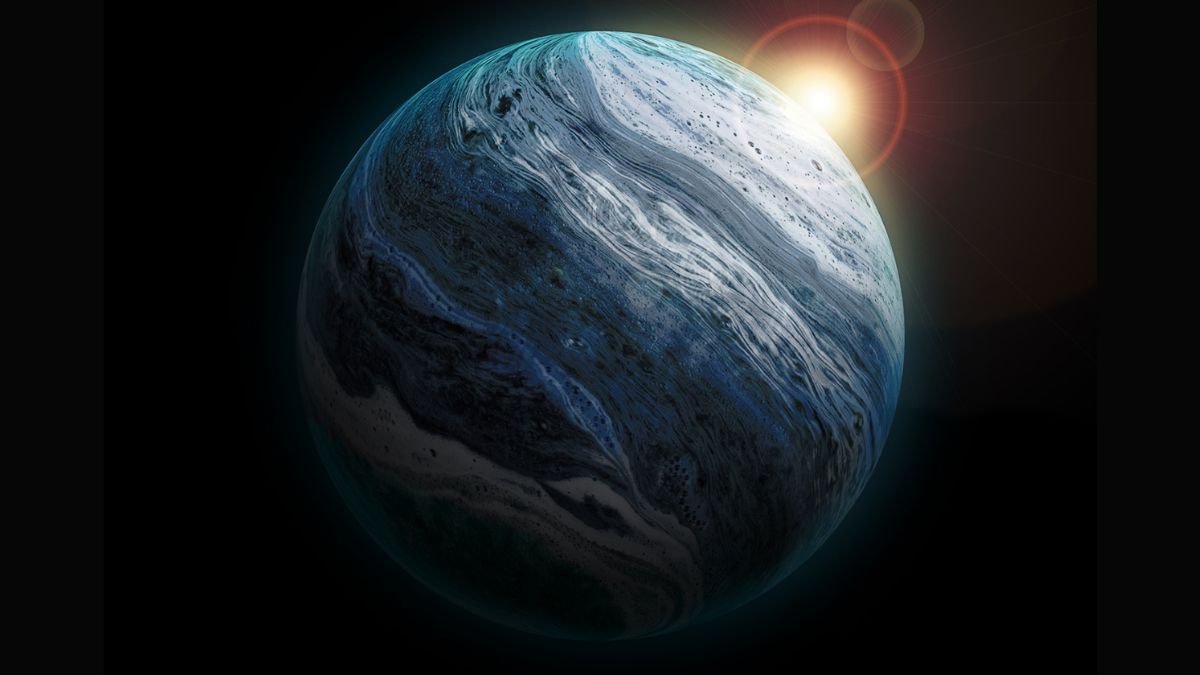
Among the thousands of exoplanets discovered beyond our Solar System, few have captured scientists’ attention like HD 189733b. Located just 63 light-years from Earth, this giant world is one of the closest and most extensively studied exoplanets ever discovered.
Although it has never been photographed directly, decades of observations have allowed astronomers to build a remarkably detailed picture of this distant planet. What they have uncovered is an alien world with scorching temperatures, hurricane-force winds, and an atmosphere where molten glass falls sideways through the sky.
A Nearby Exoplanet Unlike Anything in Our Solar System
HD 189733b orbits the star HD 189733, located in the constellation Vulpecula, also known as the Little Fox.
The star can be observed through a small telescope under dark skies in the Northern Hemisphere. The planet itself, however, remains invisible even to the most powerful current telescopes.
Instead of direct images, scientists study the planet by analyzing how the brightness and spectrum of its host star change as the planet moves in front of, beside, and behind it.
These observations have revealed one of the most extreme planetary environments ever identified.
Discovery of HD 189733b
The exoplanet was discovered on October 5, 2005, by astronomer François Bouchy and his research team at the Haute-Provence Observatory in France.
Using the Doppler spectroscopy method, researchers detected tiny gravitational movements in the host star caused by the planet’s orbit.
Key Planetary Facts
- Similar in size and mass to Jupiter
- Located about 4.6 million kilometers from its star
- Roughly 30 times closer to its star than Mercury is to the Sun
- Completes an orbit every 2.2 Earth days
- Tidally locked, meaning one side permanently faces its star
Because the same hemisphere always points toward the star, the planet experiences permanent daylight on one side and perpetual darkness on the other.
A World Heated to Extreme Temperatures
The day side of HD 189733b reaches temperatures of approximately 1,000°C (1,832°F).
Such intense heat creates enormous differences between the illuminated and dark hemispheres of the planet.
Temperature Contrast Drives Violent Weather
Measurements from NASA’s Spitzer Space Telescope found a temperature difference of roughly 260°C between the day side and night side.
This imbalance fuels some of the fastest winds ever detected on a planet.
Scientists estimate upper-atmospheric wind speeds can reach:
- 7,000 kilometers per hour
- Roughly seven times the speed of sound
For comparison, the strongest sustained winds ever recorded on Earth reached about 410 kilometers per hour during powerful tropical cyclones.
HD 189733b’s atmospheric winds are approximately 17 times faster.
The Planet Where It Rains Molten Glass
One of the most remarkable discoveries about HD 189733b involves its unusual atmospheric chemistry.
Like Jupiter, the atmosphere consists mainly of:
- Hydrogen
- Helium
However, it also contains significant quantities of silicate particles.
What Are Silicates?
Silicates are minerals commonly found in:
- Sand
- Quartz
- Earth’s crust
- Ocean-floor rocks
On HD 189733b, temperatures exceed 1,000°C, causing silicate materials to vaporize and later condense into tiny droplets of molten glass.
Sideways Glass Storms
Unlike rain on Earth, these molten particles do not fall vertically.
Instead, powerful winds sweep them sideways across the atmosphere at thousands of kilometers per hour.
Scientists believe these conditions create continuous storms of liquid glass traveling horizontally at supersonic speeds.
In this environment:
- Glass droplets remain molten
- Winds exceed 7,000 km/h
- Temperatures are hot enough to melt aluminum
The result is a planet where sideways glass rain is a permanent feature of the weather system.
Why HD 189733b Appears Blue
One of the most famous discoveries about the planet is its striking deep-blue appearance.
At first glance, the color might suggest similarities to Earth. However, the reason for the blue hue is entirely different.
Measuring the Color of an Exoplanet
In 2013, a team led by astronomer Tom Evans used the Hubble Space Telescope to determine the planet’s color through a technique called secondary eclipse spectroscopy.
Researchers observed the system as the planet passed behind its star.
By comparing:
- Light from the star alone
- Light from the star plus planet
Scientists isolated the light reflected by the planet itself.
Their analysis revealed a noticeable drop in brightness within the blue portion of the visible spectrum.
The findings showed that HD 189733b reflects blue wavelengths approximately three to four times more efficiently than red wavelengths, giving it a rich cobalt-blue appearance.
Why Earth and HD 189733b Look Similar but Are Completely Different
From space, Earth appears blue primarily because of:
- Sunlight reflecting from oceans
- Rayleigh scattering in the atmosphere
HD 189733b lacks oceans entirely.
Its temperatures are far too high for liquid water to exist.
The Source of the Blue Color
Instead, the blue coloration comes from:
- Silicate particles
- Molten glass droplets
- Atmospheric scattering of short-wavelength light
The scattering process resembles Earth’s atmospheric physics but occurs within an environment filled with vaporized minerals and liquid glass.
From a great distance, the two planets might appear remarkably similar.
Up close, they could not be more different.
Why Scientists Study HD 189733b
HD 189733b belongs to a class of exoplanets known as Hot Jupiters.
These planets:
- Have masses comparable to Jupiter
- Orbit extremely close to their stars
- Experience intense heating
- Complete orbits in only a few days
A Key Laboratory for Exoplanet Science
Because HD 189733b is relatively close to Earth and orbits a bright star, it has become one of the most valuable targets for atmospheric research.
Studies using Hubble and the James Webb Space Telescope (JWST) have identified:
- Water vapor
- Carbon dioxide
- Methane
- Atmospheric haze
These discoveries help scientists better understand planetary atmospheres beyond our Solar System.
The 2013 color measurement was also historic because it represented the first direct determination of the visible-light color of an exoplanet.
Looking Back Through Time
HD 189733b lies approximately 63 light-years from Earth.
That means every observation captures the planet as it existed 63 years ago.
The light measured by astronomers today began its journey toward Earth decades earlier.
Likewise, any civilization observing Earth from the HD 189733 system would currently see our planet as it appeared more than six decades in the past.
This cosmic delay serves as a reminder that astronomy is fundamentally an exploration of history as much as it is a study of space.
A Beautiful but Hostile Alien World
HD 189733b may be one of the most visually stunning planets discovered, appearing as a brilliant blue orb against the darkness of space.
Yet beneath that beautiful color lies a world of extreme heat, supersonic winds, and sideways storms of molten glass.
Its unique characteristics continue to provide valuable insights into the diversity of planetary systems and the complex processes shaping worlds beyond our own. As telescope technology advances, HD 189733b will remain one of the most important exoplanets for understanding the nature of alien atmospheres and the extraordinary variety of planets in our galaxy.
