
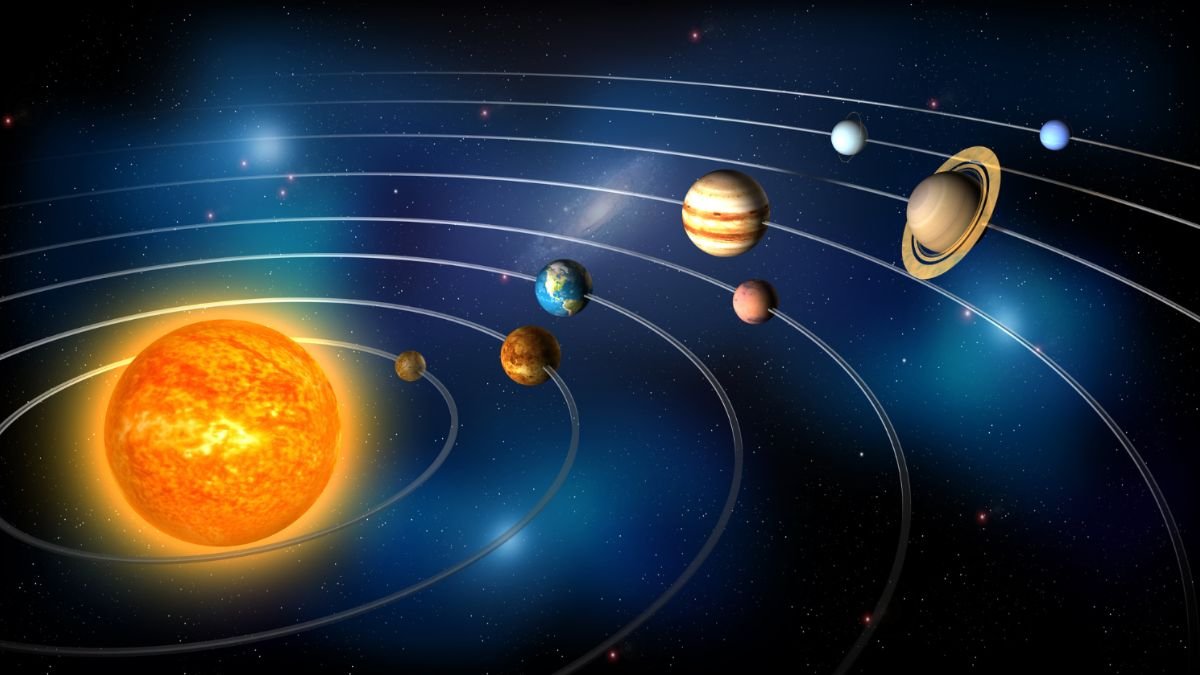
The Sun is far from stationary. Along with all the planets, asteroids, and other objects in the Solar System, it travels around the center of the Milky Way Galaxy. Completing a single orbit takes roughly 230 million years, a period often referred to as a galactic year.
This fascinating fact is frequently paired with another: about one galactic year ago, Earth was in the Late Triassic Period, when the earliest dinosaurs were beginning to appear. While the comparison is broadly accurate, astronomers and paleontologists note that both timelines involve uncertainties, and the idea that the Solar System has returned to the exact same location in the galaxy is not entirely correct.
How Long Is a Galactic Year?
Although 230 million years is the number most often cited, scientists do not agree on a single exact value.
Current estimates place the Sun’s orbital period around the Milky Way at somewhere between 225 million and 250 million years. Many astronomers favor a range closer to 220–230 million years, though the precise figure depends on improved measurements of our galaxy’s structure and rotation.
The Sun’s Journey Through the Milky Way
Researchers estimate that the Sun is located approximately:
- 26,000 light-years from the galactic center
- Traveling at roughly 230 kilometers per second
Based on these measurements, the Solar System continuously moves through the Milky Way while orbiting the galaxy’s core.
Recent observations from the European Space Agency’s Gaia mission have helped refine scientists’ understanding of the Milky Way’s rotation, pushing some estimates toward the lower end of the range.
As a result, the commonly quoted 230-million-year figure should be viewed as an approximation rather than a precise measurement.
Did Dinosaurs Really Appear One Galactic Year Ago?
The dinosaur portion of the claim largely holds up.
If the Solar System completed a galactic orbit approximately 230 million years ago, Earth would indeed have been in the Late Triassic, specifically during a stage known as the Carnian.
The Earliest Known Dinosaurs
Some of the oldest confirmed dinosaur fossils come from Argentina’s Ischigualasto Formation, which has been dated to around 230–233 million years ago.
These early dinosaurs included species such as:
- Eoraptor
- Eodromaeus
- Herrerasaurus
Unlike the giant dinosaurs that later dominated the planet, these animals were generally small, agile, and relatively uncommon.
Dinosaurs Were Not Yet Dominant
One important detail often overlooked is that dinosaurs were not the dominant animals of their time.
During the Late Triassic, they represented only a small portion of Earth’s ecosystems. Many environments were instead controlled by various crocodile-line reptiles and other prehistoric species.
Dinosaurs did not become the primary land animals until after the end-Triassic extinction event, approximately 201 million years ago, which eliminated many competing groups.
This means that while dinosaurs existed one galactic year ago, they were still in the early stages of their evolutionary rise.
Have We Returned to the Same Place in the Galaxy?
The popular phrase suggesting that the Solar System has traveled “this far around the galaxy” creates a misleading image.
While the Sun may have completed approximately one orbit, it has not returned to the exact same galactic neighborhood.
The Milky Way Is Constantly Changing
Several factors prevent a perfect return to the original location:
- The galaxy rotates differentially, meaning stars at different distances move at different speeds.
- Spiral arms are not fixed structures but dynamic wave-like patterns.
- The Sun moves above and below the galactic plane.
- The Solar System gradually shifts its position within the galaxy over time.
As a result, the Sun may return to a similar angular position relative to the galactic center, but the surrounding stars, gas clouds, and spiral-arm structure are entirely different.
The Clock Returns, the Location Does Not
A useful way to think about a galactic year is as a cosmic clock rather than a journey back to the same place.
The timing may repeat, but the galaxy itself has evolved significantly during the intervening millions of years.
Does the Sun’s Galactic Motion Affect Life on Earth?
Some researchers have explored whether the Solar System’s movement through the Milky Way influences biological events on Earth.
One hypothesis proposed in the 1980s suggested that the Sun’s oscillations through the galactic plane might periodically disturb distant comet reservoirs, increasing the likelihood of impacts on Earth and potentially contributing to mass extinctions.
A Controversial Idea
While the theory remains intriguing, it has not been conclusively proven.
Scientists have identified several challenges:
- The timing of galactic plane crossings does not consistently align with extinction events.
- Evidence for regular extinction cycles remains debated.
- No direct causal connection has been established.
For now, the concept remains an active area of discussion rather than an accepted scientific conclusion.
Future Research Could Refine the Timeline
As missions such as Gaia continue gathering data, astronomers expect to improve measurements of the Milky Way’s structure and the Sun’s orbit.
These refinements may slightly alter estimates of the galactic year and provide a more detailed picture of the Solar System’s long-term movement through space.
However, the broader conclusion is unlikely to change.
A Fascinating Connection Between Cosmic and Earth History
The most reasonable interpretation of the famous “one galactic year ago” statement is a modest one: approximately one orbit around the Milky Way in the past, Earth was home to the earliest known dinosaurs.
Those ancient animals were still rare, relatively small, and far from becoming the dominant creatures they would eventually become.
The comparison offers a striking reminder of both the immense timescales involved in galactic motion and the extraordinary history of life on our planet.
