
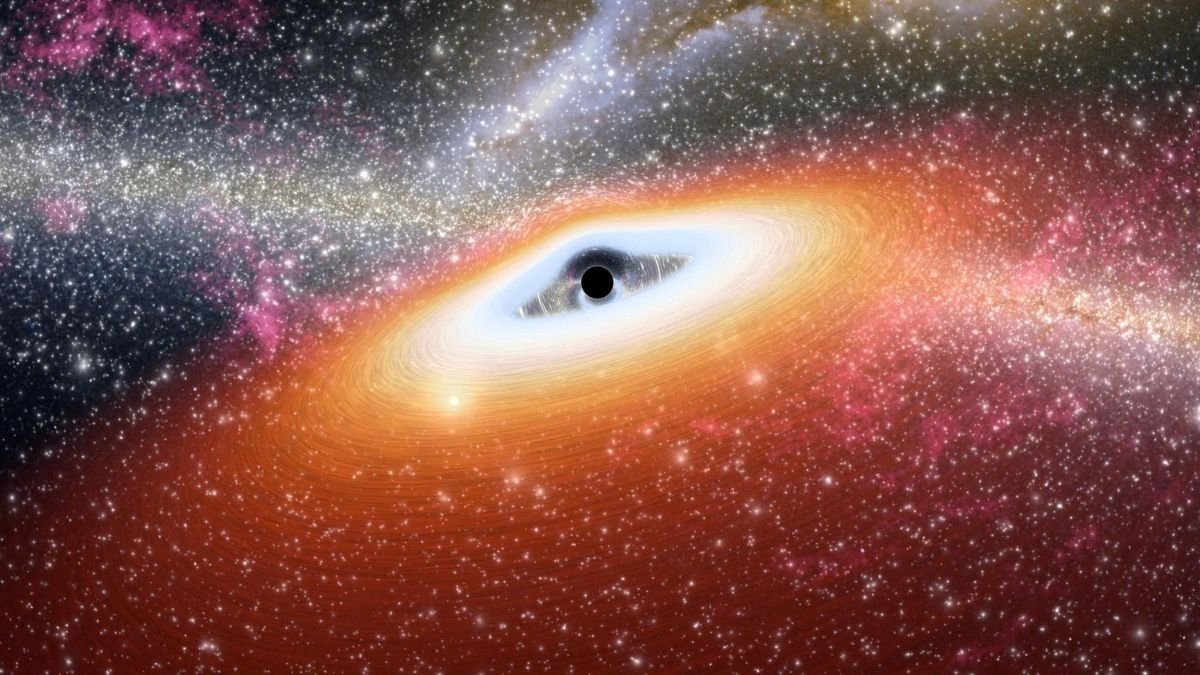
One of the most persistent mysteries in modern physics—the black hole information paradox—may have a promising new explanation. Researchers have proposed a theoretical framework that not only addresses how information survives inside black holes but could also shed light on one of particle physics’ biggest questions: where fundamental particles get their mass.
The study, published in General Relativity and Gravitation, presents a model that combines black hole physics, extra dimensions, and spacetime geometry into a single theoretical approach.
The Long-Standing Black Hole Information Problem
The paradox dates back to the 1970s when physicist Stephen Hawking demonstrated that black holes emit a faint form of energy now known as Hawking radiation.
According to Hawking’s calculations, black holes gradually lose energy through this radiation and eventually evaporate completely. However, this creates a major conflict with quantum mechanics.
Quantum theory states that information can never be permanently destroyed, a principle known as unitarity. Yet if a black hole vanishes entirely, the information associated with everything that fell into it would seemingly disappear forever.
This contradiction has remained one of the most significant unresolved issues in theoretical physics.
A New Approach Involving Extra Dimensions
The new research, led by Richard Pinčák and colleagues, explores a gravity model based on Einstein-Cartan theory within a seven-dimensional universe.
Unlike Einstein’s general relativity, which describes gravity through the curvature of spacetime, Einstein-Cartan theory introduces an additional feature known as spacetime torsion.
What Is Spacetime Torsion?
In this framework, spacetime can not only bend but also twist.
The researchers built their model using a mathematical structure called a G2-manifold with torsion, which exists in seven dimensions rather than the familiar four dimensions of space and time.
Their calculations suggest that at the extremely high densities found near the Planck scale, torsion generates a repulsive effect that prevents complete gravitational collapse.
Black Holes May Leave Behind Stable Remnants
Instead of evaporating entirely, the model predicts that black holes would stop shrinking at a certain point and leave behind a stable remnant.
According to the study, this remnant would possess a mass of approximately:
9 × 10⁻⁴¹ kilograms
This tiny leftover object could provide the key to solving the information paradox.
If the black hole never completely disappears, the information stored within it may survive as well.
Black Hole Remnants as Information Storage Devices
The researchers propose that these remnants act as long-term information repositories.
Information would be preserved through a collection of persistent oscillations known as quasi-normal modes, which emerge within the torsion field.
Enormous Information Capacity
The team’s calculations indicate that a remnant produced from a black hole with the mass of the Sun could theoretically store:
1.515 × 10⁷⁷ qubits of information
This enormous storage capacity would be sufficient to preserve all information associated with the original black hole, potentially resolving the paradox that has challenged physicists for decades.
Implications for Particle Physics
The study extends beyond black holes and may also help explain the origin of particle mass.
When the researchers mathematically reduced their seven-dimensional model to the four-dimensional universe we observe, they found that the process naturally generated the electroweak scale of approximately:
246 GeV
This energy scale plays a crucial role in the Standard Model of particle physics and is closely linked to the Higgs field, which is responsible for giving elementary particles their mass.
Connecting Torsion to the Higgs Field
Within the proposed framework, the vacuum expectation value (VEV) of the torsion field becomes directly associated with the electroweak scale.
This suggests that the same geometric mechanism responsible for preserving information in black holes may also explain why particles have vastly different masses.
The idea offers a potential solution to the long-standing mass hierarchy problem, one of the major unanswered questions in particle physics.
Why Haven’t Extra Dimensions Been Detected?
A natural question is why scientists have not observed evidence for these extra dimensions.
According to the researchers, the answer lies in the enormous energy scales involved.
Theoretical particles associated with the extra dimensions, known as Kaluza-Klein excitations, are predicted to have masses of roughly:
8.6 × 10¹⁵ GeV
This energy level is about seven orders of magnitude beyond what the Large Hadron Collider (LHC) can currently achieve.
As a result, direct detection remains far beyond the capabilities of modern particle accelerators.
Possible Ways to Test the Theory
Although current colliders cannot reach the required energy scales, the model still produces several testable predictions.
Black Hole Remnants as Dark Matter
One intriguing possibility is that these stable remnants could contribute to the universe’s unexplained dark matter.
If scientists were able to detect the gravitational effects of these tiny relics, it would provide strong evidence supporting the theory.
Signals from the Early Universe
The model also predicts that traces of the proposed seven-dimensional geometry may be visible in:
- The cosmic microwave background (CMB)
- Primordial gravitational waves
- Early-universe cosmological signatures
Future astronomical observations could therefore offer indirect evidence for the framework.
A New Perspective on Reality
One of the most compelling aspects of the research is its attempt to connect multiple mysteries through a single geometric structure.
Rather than requiring a complete revision of quantum mechanics, the theory suggests that black holes, particle mass, and the fundamental architecture of spacetime may all emerge from a deeper seven-dimensional reality.
If future studies support these findings, the work could represent a major step toward unifying some of the most challenging problems in modern physics.
