
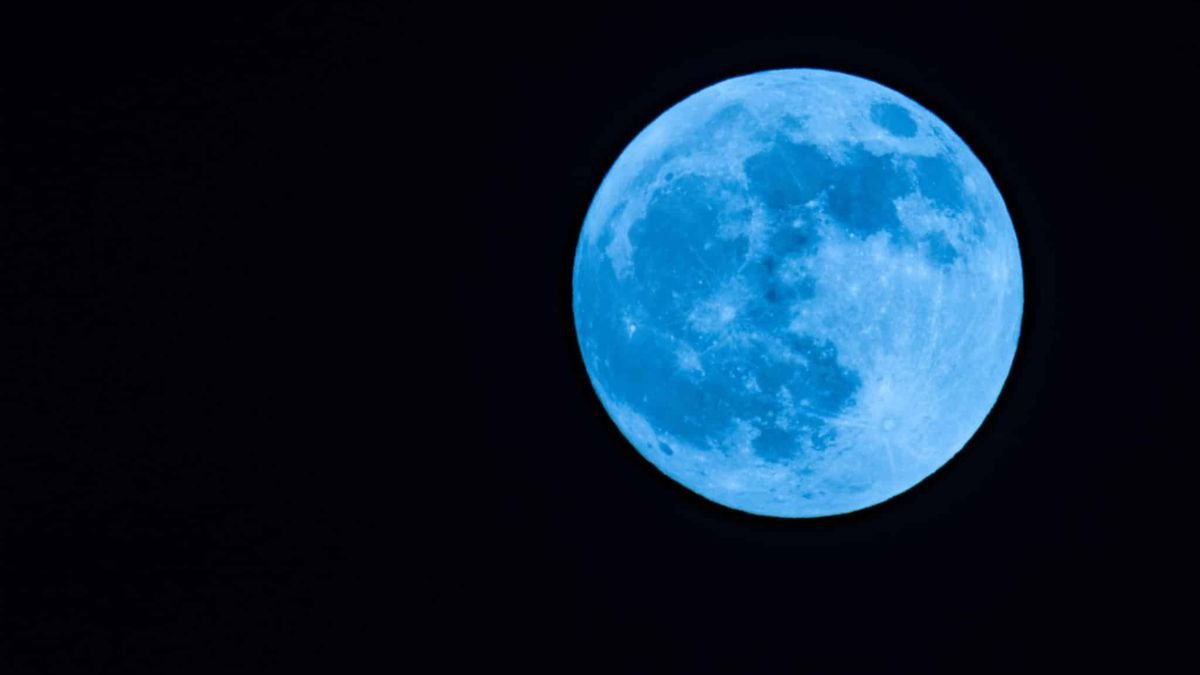
Skywatchers are in for an unusual celestial event this weekend as a blue micromoon appears in the night sky. While the name may sound dramatic, the phenomenon combines two separate lunar events that rarely occur at the same time.
Here’s a closer look at what a blue micromoon is, how uncommon it is, and the best opportunities to see it.
Understanding a Blue Moon
Despite its name, a blue moon has nothing to do with the moon changing color.
The most widely used definition refers to the second full moon occurring within a single calendar month. Since the moon completes its lunar cycle approximately every 29.5 days, most months contain only one full moon. Occasionally, however, the timing allows for two full moons in the same month, with the second one earning the title of a blue moon.
There is also another, less commonly used definition known as a seasonal blue moon.
In that case, a blue moon occurs when an astronomical season contains four full moons instead of the usual three. The third full moon in that sequence is designated as the seasonal blue moon.
The event occurring this weekend falls under the more familiar monthly blue moon category.
What Is a Micromoon?
A micromoon relates to the moon’s distance from Earth at the time of a full moon.
Because the moon travels around Earth in an elliptical orbit rather than a perfectly circular one, its distance constantly changes.
When a full moon occurs near the moon’s closest point to Earth, it is called a supermoon. Conversely, when the full moon takes place near the moon’s farthest point from Earth, it is known as a micromoon.
Although the term may suggest a dramatically smaller moon, the difference is relatively subtle.
A micromoon appears:
- About 14% smaller than a supermoon
- Roughly 6% smaller than an average full moon
Most casual observers may not immediately notice the size difference without comparison images.
How Uncommon Is a Blue Micromoon?
Both blue moons and micromoons occur periodically, but seeing them together is far less common.
Frequency of Each Event
- Blue moons occur roughly every two to three years.
- Micromoons typically happen two or three times each year.
Because the two events must coincide, a blue micromoon generally appears only about once every couple of decades.
However, these occurrences do not follow a perfectly regular schedule. Some blue micromoons may happen relatively close together, while others can be separated by many years.
Time zones and calendar differences around the world can also influence whether a particular full moon qualifies as a blue moon in different regions.
Based on the same definition used for this year’s event, the next blue micromoon visible in the United Kingdom is not expected until 2066, although some countries, including the United States, may experience one sooner, in 2053.
Will the Moon Actually Look Blue?
The answer is no.
A blue moon refers solely to its position in the calendar and not its appearance.
That said, there are rare circumstances when the moon can take on a bluish tint.
This can happen after significant volcanic eruptions or major wildfires when large amounts of dust, smoke, or particles enter the atmosphere. These particles can alter the way light is scattered, occasionally creating a blue-colored appearance.
Such events are unrelated to the blue moon phenomenon itself.
Best Time to See the Blue Micromoon
The full moon reaches its peak phase on May 31 at 9:45 a.m. BST.
Equivalent times include:
- 4:45 a.m. Eastern Time (US)
- 6:45 p.m. AEST (Australia)
For many observers, including those in the United Kingdom, the moon will have already set by the exact moment it becomes full.
Fortunately, the moon will still appear virtually full both the night before and the night after the official peak.
As a result, Saturday and Sunday evenings offer excellent opportunities for viewing.
Viewing Conditions by Hemisphere
- In the Northern Hemisphere, the moon will remain relatively low above the horizon throughout the night.
- In the Southern Hemisphere, observers will see the moon much higher in the sky.
Clear weather and minimal light pollution will provide the best viewing experience.
Is This Connected to the Phrase “Once in a Blue Moon”?
The exact origin of the popular expression remains uncertain.
Because blue moons occur every few years, they are somewhat uncommon but not exceptionally rare.
Some astronomers believe the phrase may instead be linked to the genuinely rare occasions when atmospheric conditions cause the moon to appear blue due to volcanic ash or wildfire smoke.
Regardless of its origins, the expression has become synonymous with events that occur infrequently.
Why This Lunar Event Matters
The blue micromoon serves as a reminder of the fascinating mechanics governing Earth’s nearest celestial neighbor. While the moon may not appear blue and the size difference may be subtle, the combination of a blue moon and a micromoon creates a relatively rare astronomical event that won’t return frequently.
For stargazers and casual skywatchers alike, this weekend offers a chance to witness an unusual lunar occurrence that combines rarity, science, and a bit of celestial history.
