
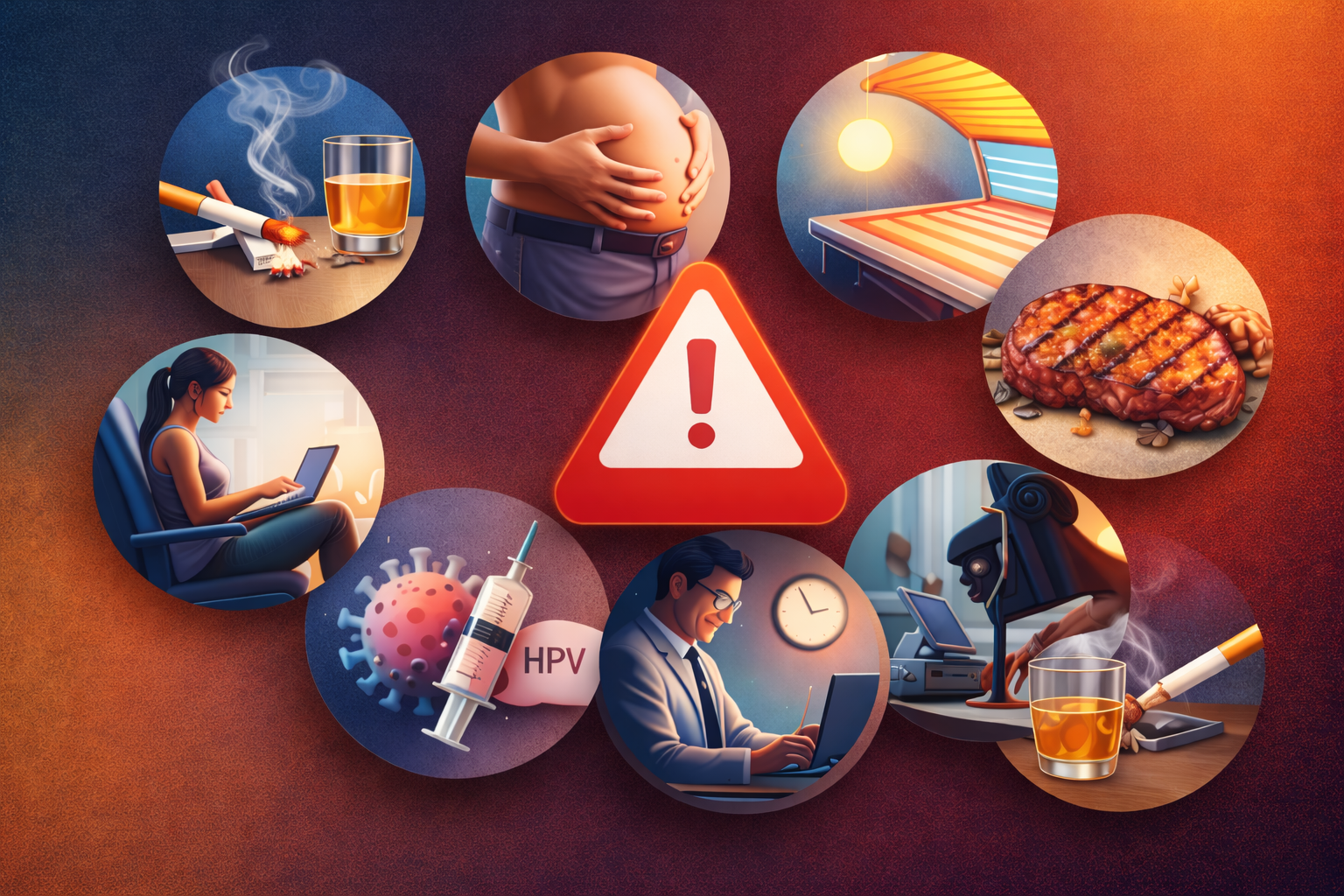
Cancer risk is not shaped by one dramatic event alone. More often, it builds slowly through repeated daily patterns that seem harmless: a regular drink in the evening, too much sitting, frequent processed foods, unprotected sun exposure, tobacco smoke, and weight gain that creeps up over time.
Researchers now estimate that about 40% of cancer cases and nearly half of cancer deaths in adults are linked to modifiable risk factors, which means many cases are influenced by habits people can change.
That does not mean every cancer is preventable, and it does not mean blame belongs on individuals. It means daily routines matter more than most people realize.
Why Daily Habits Matter
Cancer develops when cells acquire damage that allows them to grow uncontrollably. Some daily habits increase that risk by damaging DNA, driving chronic inflammation, disrupting hormones, weakening immune surveillance, or increasing exposure to carcinogens.
The effect is often cumulative. A single unhealthy meal or one missed workout is not the issue. The problem is repetition over years. That is why “quiet” risks deserve attention: they rarely feel urgent in the moment, but they can matter greatly over time.
Quick Table: Everyday Habits And Their Cancer Link
| Habit | Why It Raises Risk | Cancers Commonly Linked |
|---|---|---|
| Smoking or regular secondhand smoke exposure | Delivers carcinogens that damage cells and DNA | Lung, mouth, throat, esophagus, bladder, pancreas, kidney, cervix, and more |
| Regular alcohol use | Produces acetaldehyde, increases oxidative stress, alters hormones | Breast, liver, colorectal, mouth, throat, esophagus, larynx |
| Too little physical activity | Affects hormones, inflammation, insulin regulation, and weight | Colon, breast, endometrial, kidney, stomach, esophagus, bladder, lung |
| Excess body weight | Raises inflammation, insulin, and hormone exposure | 13 obesity-related cancers including colorectal, breast after menopause, uterus, kidney, liver, pancreas |
| Frequent processed meat intake | Linked to carcinogenic compounds and colorectal risk | Colorectal cancer, with possible stomach risk |
| Too much UV exposure or indoor tanning | Damages skin-cell DNA | Melanoma, basal cell, squamous cell skin cancers |
| Repeated night shift or chronic circadian disruption | May alter hormone rhythms and repair cycles | Most strongly linked with breast cancer risk in women with persistent night shift exposure |
| Skipping HPV vaccination and prevention | Leaves people vulnerable to high-risk HPV infection | Cervical, anal, penile, vulvar, vaginal, and some throat cancers |
Smoking And Secondhand Smoke Are Still Major Risks
The most important everyday habit tied to cancer remains tobacco exposure. Smoking causes about 20% of all cancers and about 30% of cancer deaths in the United States. It is linked not only to lung cancer but also to cancers of the mouth, throat, larynx, esophagus, pancreas, bladder, kidney, liver, stomach, colon and rectum, cervix, and acute myeloid leukemia.
Even people who do not smoke are not fully protected if they live or work around smoke. Secondhand smoke contains more than 7,000 chemicals, including about 70 known carcinogens, and it can cause lung cancer in adults who never smoked.
What makes this risk “quiet” is familiarity. Some people smoke only socially, assume light smoking is safer, or believe opening a window protects others. It does not eliminate exposure. The safest choice is to avoid both smoking and routine secondhand smoke altogether.
Alcohol Is More Harmful Than Many People Think
A drink with dinner is often seen as normal, but alcohol is a proven human carcinogen. It is linked to at least 7 types of cancer: mouth, throat, larynx, esophagus, liver, colorectum, and breast. Risk is not limited to heavy drinking.
Current health agencies emphasize that the risk can rise even at low levels, and the type of drink does not change that risk because ethanol itself and its byproduct acetaldehyde are carcinogenic. In the United States, alcohol is associated with about 100,000 cancer cases and around 20,000 cancer deaths each year.
This matters because many adults do not connect moderate drinking with cancer. For women especially, even lower amounts can still contribute to risk, particularly for breast cancer. The practical takeaway is simple: less alcohol means less cancer risk.
Sitting Too Much And Moving Too Little
Modern life is engineered for sitting: desks, cars, screens, and late-night scrolling. But low physical activity is consistently associated with a higher risk of several cancers. Regular movement helps regulate insulin, lowers inflammation, supports a healthier body weight, and improves hormone balance.
Adults who are more physically active have lower risks of cancers including bladder, breast, colon, endometrium, esophagus, kidney, lung, and stomach. General adult guidance remains at least 150 minutes of moderate-intensity activity per week, or 75 minutes of vigorous activity, plus muscle-strengthening activity on 2 days weekly.
The danger here is not only being “inactive” in the formal sense. It is long stretches of sedentary time repeated daily. A gym session helps, but it does not fully erase the effects of sitting for most of the day. More walking breaks, stairs, standing meetings, and consistent movement across the week are better for long-term risk reduction.
Gradual Weight Gain Can Quietly Raise Risk
Excess body weight is tied to a higher risk of 13 cancers, and these obesity-associated cancers account for about 40% of all cancers diagnosed in the United States each year.
They include cancers of the colon and rectum, breast after menopause, uterus, kidney, liver, pancreas, ovary, thyroid, upper stomach, gallbladder, esophagus adenocarcinoma, meningioma, and multiple myeloma. Excess body fat can raise estrogen, insulin, and inflammation, all of which can promote cancer development.
This is a quiet risk because weight gain often happens slowly over years. A few extra kilos may feel cosmetic, but biologically they can affect metabolism and hormones in meaningful ways.
The goal is not crash dieting. It is long-term weight stability through better food quality, regular movement, sleep, and reduced alcohol intake.
Processed Meat And Frequently Charred Meat Deserve More Attention
Eating processed meat often is another habit that tends to fly under the radar. Processed meat has been classified as carcinogenic to humans, with the strongest evidence for colorectal cancer.
Research reviewed by international experts found that every 50-gram daily portion of processed meat raises colorectal cancer risk by about 18%. That is roughly the amount in a hot dog or a few slices of bacon. There is also evidence suggesting an association with stomach cancer.
Cooking meat at very high temperatures, especially over open flames until heavily charred, can also create mutagenic chemicals such as heterocyclic amines and polycyclic aromatic hydrocarbons, which can damage DNA.
This does not mean meat must be eliminated entirely, but frequent intake of processed and heavily charred meat is worth reducing. Swapping in beans, lentils, fish, eggs, or minimally processed lean proteins more often is a practical step.
Sun Exposure And Indoor Tanning Are Not Harmless
Too much ultraviolet radiation from the sun, tanning beds, or sunlamps is the main preventable cause of most skin cancers. Public health guidance is clear that most skin cancers are caused by too much UV exposure. The danger is not limited to beach vacations.
Daily incidental sun on the face, neck, arms, and hands adds up. Indoor tanning is particularly risky: using a sunbed even once is associated with about a 20% higher risk of melanoma, and first use before age 35 has been linked to a 59% higher risk. Globally, more than 1.5 million skin cancer cases were diagnosed in 2020.
A tan is not a sign of health. It is skin injury. Protective clothing, shade, sunscreen, and avoiding tanning beds are some of the simplest cancer-prevention habits available.
Chronic Night Shift Work And Disrupted Sleep Timing
Sleep itself is important for overall health, but one specific pattern now draws growing concern: long-term night shift work and chronic circadian disruption. A recent U.S. hazard assessment concluded that persistent night shift work can cause breast cancer in women. The theory is that repeated disruption of the body clock may affect hormone rhythms, melatonin, immune function, and cellular repair.
This is not a reason for panic among everyone who works late occasionally. The strongest concern is for persistent, long-duration night work over years. Still, it highlights a broader point: cancer prevention is not only about food and exercise. Biological timing matters too.
People who must work nights can reduce strain by keeping the sleep schedule as regular as possible, limiting unnecessary light exposure before sleep, and prioritizing routine health checks.
Skipping HPV Prevention Can Leave A Major Risk Unchecked
Some cancer risks are shaped by what people fail to do. HPV vaccination is one of the clearest examples. The vaccine has the potential to prevent more than 90% of cancers caused by HPV, including many cases of cervical cancer, as well as anal, penile, vulvar, vaginal, and some throat cancers. Real-world data continue to show major reductions in HPV infections and precancers after vaccination programs.
This belongs in any honest discussion of everyday cancer risk because prevention is not only about avoiding harmful exposures. It is also about using proven protection. For eligible age groups, staying updated with vaccination and screening is one of the most effective anti-cancer habits available.
How To Lower Your Risk In Real Life
The most effective strategy is not perfection. It is consistency. Avoid tobacco, reduce or eliminate alcohol, move more every week, protect your skin from UV, keep processed meat occasional rather than routine, maintain a healthy weight, and stay up to date with vaccines and recommended screenings. These changes may sound ordinary, but ordinary habits are exactly where cancer risk often begins to shift.
Conclusion
Cancer is a complex disease, and no lifestyle plan can guarantee full protection. Genetics, age, environment, and chance also matter. But the evidence is strong that several common daily habits quietly increase risk over time.
Smoking, alcohol, inactivity, excess weight, processed meat, too much UV exposure, chronic circadian disruption, and missed HPV prevention all deserve serious attention. The encouraging part is that these are not abstract dangers.
They are practical areas where small, repeated improvements can make a real difference over the years. The most powerful anti-cancer habits are often the least glamorous: moving regularly, eating more carefully, protecting your skin, avoiding tobacco, drinking less, and taking prevention seriously before disease appears.
FAQs
Can Healthy People Still Get Cancer?
Yes. Even people with strong habits can develop cancer because genetics, age, infections, environmental exposures, and chance also play roles. Healthy habits lower risk; they do not make risk zero.
Is Moderate Alcohol Use Really Linked To Cancer?
Yes. Current evidence shows that even lower levels of alcohol can increase cancer risk, and no type of alcoholic drink is considered risk-free for cancer.
Which Habit Has The Biggest Impact On Cancer Risk?
Smoking remains the biggest modifiable lifestyle risk for cancer overall, causing about 20% of all cancers and around 30% of cancer deaths in the United States.